

Design Thinking – what is it?
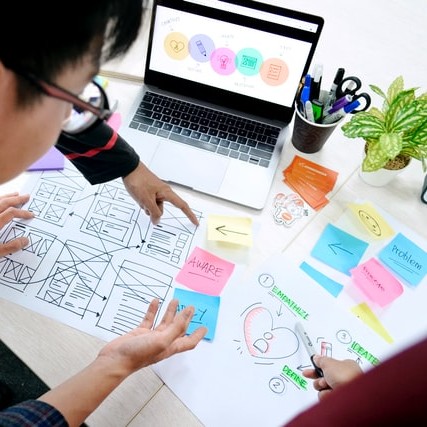
The famous inventor, engineer, businessman, and holder of no fewer than 186 patents Charles Kettering once said “If you have always done it that way, it is probably wrong.”
If you’re a designer, an entrepreneur, or any kind of employee, you are no stranger to the constant pressure to innovate. It’s the secret sauce, after all; the key to progress and success. Our capacity for innovation – the ability to conceive ideas which are at once actionable and effective – is what gives us the upper hand in competitive industries.
But you know that innovation doesn’t always come that easily. That’s where design thinking comes in.
Design Thinking originally came about as a way of teaching engineers how to approach problems creatively, like designers do.
With the rise of human-centered design in the 80s and the formation of design consultancy IDEO in the 90s, design thinking became increasingly popular. By the start of the 21st century, design thinking was making its way into the world of business. In 2005, Stanford University’s d.school began teaching design thinking as an approach to technical and social innovation.
So what exactly is design thinking? Design thinking is both an ideology and a process that seeks to solve complex problems in a user-centric way. It focuses on achieving practical results and solutions that are:
- Technically feasible: They can be developed into functional products or processes;
- Economically viable: the business can afford to implement them
- Desirable for the user: They meet a real human need.
The ideology behind design thinking states that, in order to come up with innovative solutions, one must adopt a designer’s mindset and approach the problem from the user’s perspective. At the same time, design thinking is all about getting hands-on; the aim is to turn your ideas into tangible, testable products or processes as quickly as possible. The design thinking process outlines a series of steps that bring this ideology to life – starting with building empathy for the user, right through to coming up with ideas and turning them into prototypes.
The five of design thinking’s most important principles are:
- User-centricity and empathy
Design thinking is all about finding solutions that respond to human needs and user feedback. People, not technology, are the drivers of innovation, so an essential part of the process involves stepping into the user’s shoes and building genuine empathy for your target audience. - Collaboration
The aim of design thinking is to pool a diverse variety of perspectives and ideas; this is what leads to innovation! Design Thinking encourages collaboration between heterogeneous, multidisciplinary teams which may not typically work together. - Ideation
Design thinking is a solution-based framework, so the focus is on coming up with as many ideas and potential solutions as possible. Ideations is both a core design thinking principle and a step in the design thinking process. The ideation step is a designated judgment-free zone where participants are encouraged to focus on the quantity of ideas, rather than the quality. One tool for ideation is Lego Serious Play. If you want to know more about it, read here. - Experimentation and iteration
it’s not just about coming up with ideas; it’s about turning them into prototypes, testing them, and making changes based on user feedback. Design thinking is an iterative approach, so be prepared to repeat certain steps in the process as you uncover flaws and shortcomings in the early versions of your proposed solution. - A bias towards action
Design thinking is an extremely hands-on approach to problem-solving favoring action over discussion. Instead of hypothesizing about what your users want, design thinking encourages you to get out there and engage with them face-to-face. Rather than talking about potential solutions, you’ll turn them into tangible prototypes and them them in real-world contexs.